

Say the word out loud. Bon.
It's one of the first words you meet in 3 Minute French, and probably the friendliest. Three letters. One soft, rounded syllable that hums rather than ends. It means good, and it shows up everywhere. In bonjour (good day), in bonsoir (good evening), in bon appétit, bonne nuit, bon voyage. You can't get through a day in France without hearing it a dozen times.
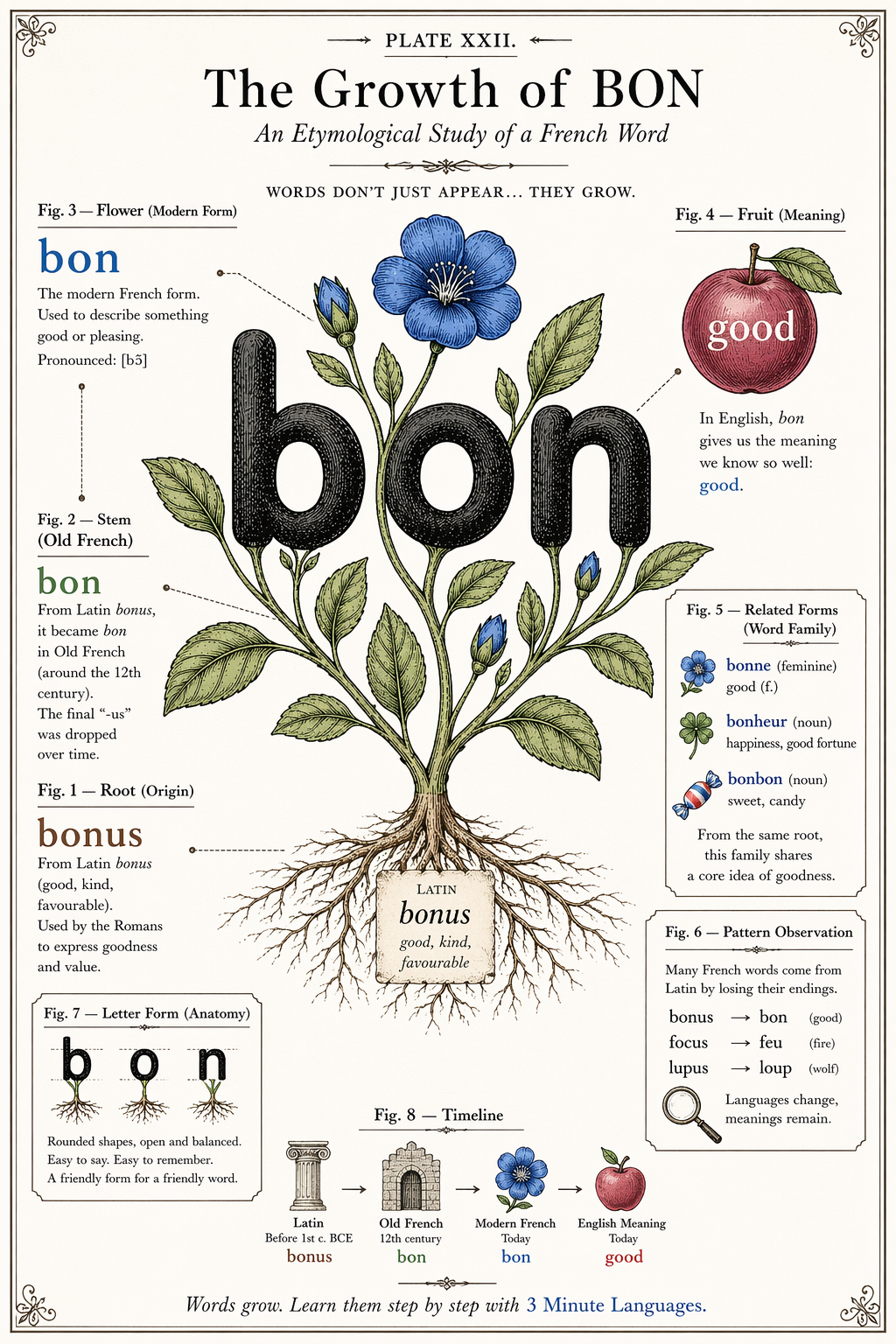
But here's the thing most people never stop to think about. Bon didn't just appear in the French language one morning, ready-made and waiting to be used. It grew slowly, over roughly two thousand years, and it pushed its way up through Latin soil, lost a few bits along the way, and eventually flowered into the little word we use today.
And if you understand how bon grew, something quietly magical happens. You start to realise that thousands of French words grew the same way, and that because you already speak English, you're already halfway to speaking a great many of them.
Let me show you what I mean.
A Roman soldier walks into a tavern

Picture Gaul, somewhere around the year 50 BCE. Julius Caesar's legions have marched in, set up camp, and aren't going anywhere for a while. The locals speak a patchwork of Celtic dialects. The soldiers speak Latin, but not the polished, elegant Latin of Cicero and the Senate. They speak what scholars now call Vulgar Latin, the everyday spoken version, the kind of Latin you'd hear in a barracks or a market square.
And one of the words these soldiers would have used a hundred times a day was bonus.
Bonus meant good. It was used to tell a friend the bread is good or the weather is nice. Good wine. Good horse. Good idea. Bonus, bona, bonum, depending on whether the noun you were describing was masculine, feminine, or neuter. The Romans left eventually, but their language stayed. And over the centuries, as generation after generation of ordinary people spoke it, wore it down, and reshaped it in their mouths, bonus began to change.
The quiet death of the ending
Here's a curious thing about languages: the ends of words are the first bits to go.
Think about how you actually speak English. You probably say gonna instead of going to, wanna instead of want to. You swallow the ends of words. You smooth things off. Everybody does this, in every language that has ever existed. It's called erosion, and it's one of the main engines of how languages change.
So picture a Gaulish farmer, in the year 400, saying bonus. Then his grandson in 600, saying it a bit quicker. Then his great-great-grandson in 800, barely pronouncing the -us at all. By the time we get to the 12th century, the ending has fallen off entirely. Bonus has become bon.
And here's where it gets interesting for us as language learners.
The words you didn't know you knew
The same thing that happened to bonus happened to almost every Latin word. The endings fell away. Vowels softened. And the words that came out the other side are the words of modern French, which means French is, in a very real sense, Latin with the ends chewed off.
Now, English isn't descended from Latin. English is a Germanic language. But here's the twist: in the year 1066, a Frenchman called William the Conqueror (or Guillaume le Conquérant in French) invaded England, and for the next three hundred years the ruling classes of England spoke French. They spoke French, and left their fingerprints all over English. Thousands of French words slipped into our language and never left.
Which means that when you look at a French word today, there's a very good chance you already recognise it.
Don't believe me? Here, try these. They're all real French words. Read them out loud and see what they look like:
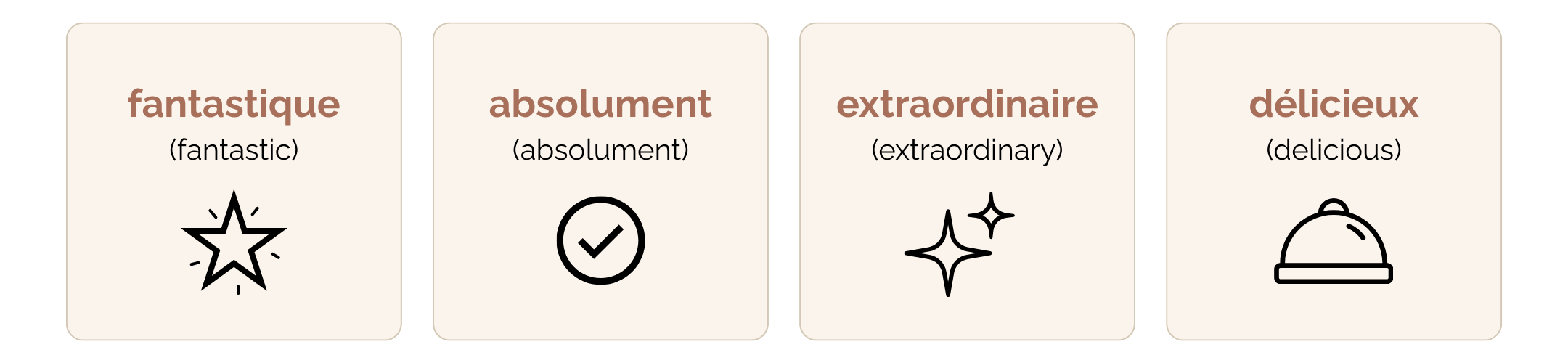
This isn't a trick. It's not a handful of cherry-picked examples. There are thousands of words like this sitting in French, waiting for you to walk up and claim them. Once you've noticed the pattern, you start spotting them everywhere: on menus, on signs, in songs. And every one you spot is a word you don't have to learn. You already know it.
Three minutes. Let's actually speak some French.
Ready? Here we go.
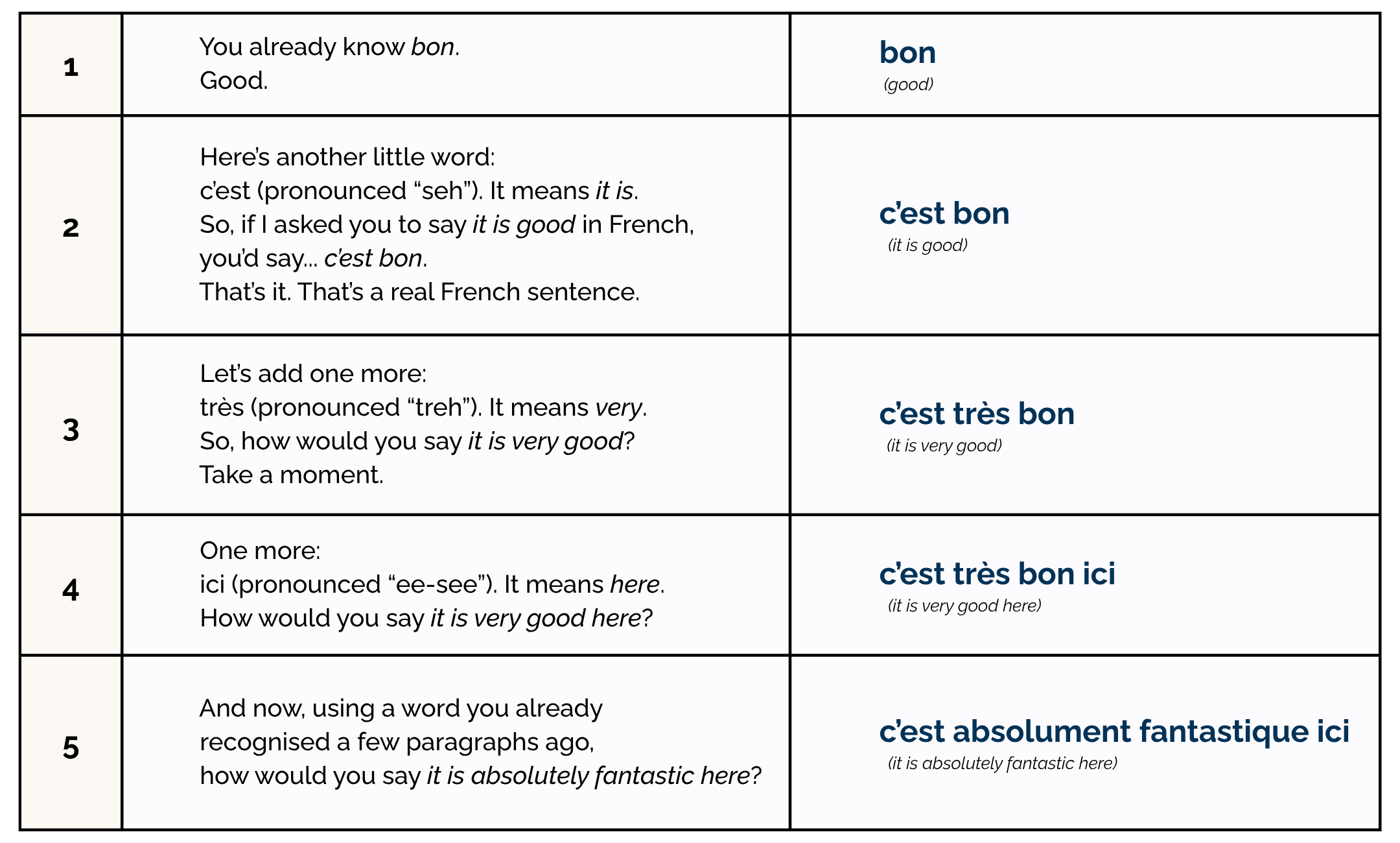
That's not a gimmick. That's how the language actually works.
Why this all matters
But French isn't arbitrary. Every word in it has a story. Every word came from somewhere, carrying meaning on its back through the centuries, picking up a bit of mud here, dropping a syllable there. When you learn a French word, you're not memorising a random code. You're meeting something alive, and often, something you already half-know.
And when you start to see the patterns like the dropped Latin endings, the English cousins sitting in plain sight, and the way five small words can snap together into a real sentence, French stops being a wall and starts being a garden that you can walk in and have a wander around. And you realise you can speak, right from the very first lesson.
Ready to grow your French
Three minutes a day. That's all it takes. The reason it works is simple: you keep your enthusiasm fresh, you build a daily habit that's impossible to break, and your brain actually remembers things better in small doses than in long ones. A three-minute chunk every day will teach you more French in a month than a three-hour binge ever could.
If what just happened in the last few paragraphs felt like something you click with, if the idea of actually speaking French from day one, in little daily bites, sounds more like you than slogging through textbook grammar, then come and join 3 Minute French. The first few lessons are free. See if it clicks.
Because words grow. And given a little time, patience, and three minutes a day, so does your French.
Bon courage.
Kieran

Do not miss!
Great offer today!